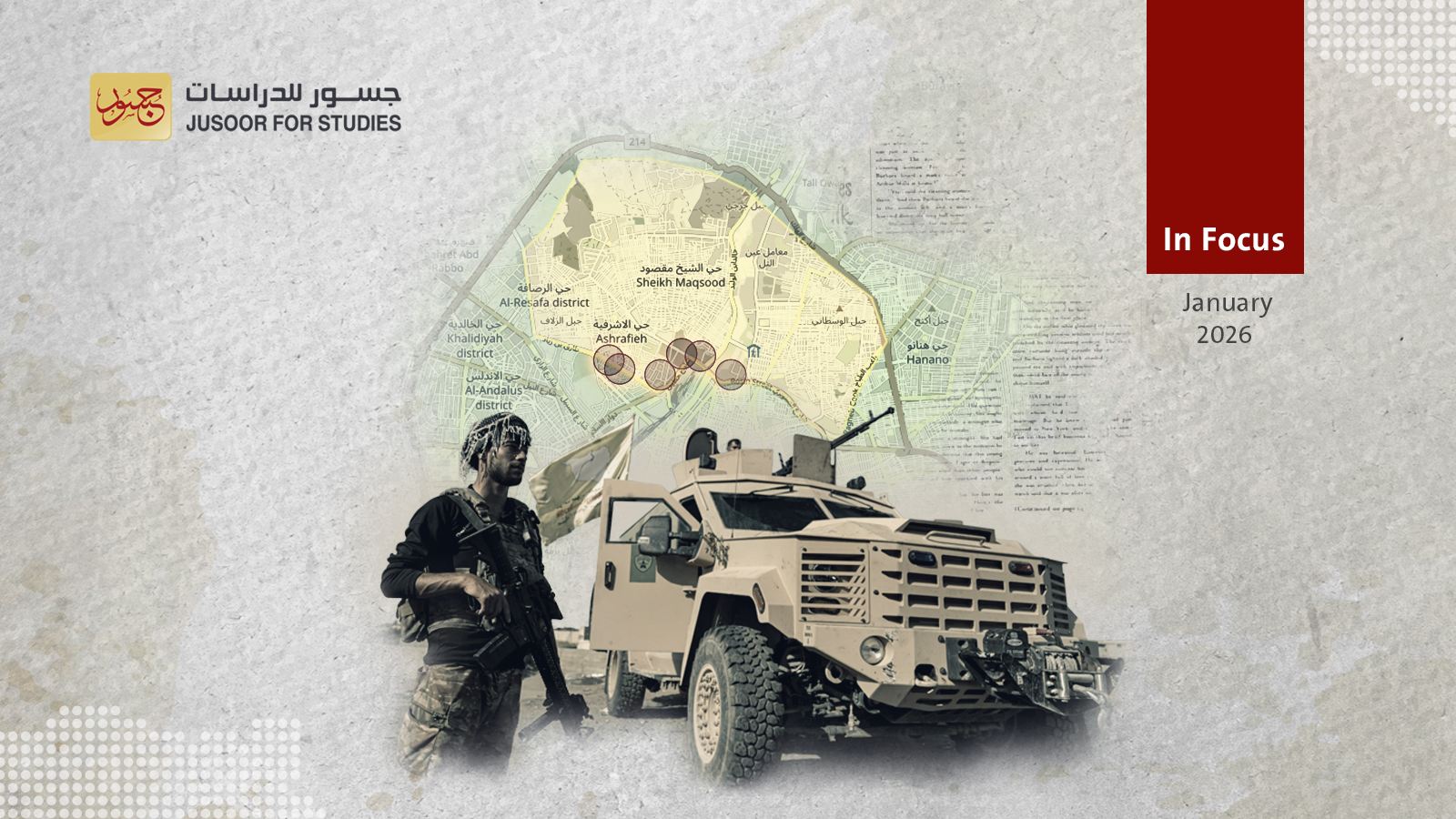
Aleppo Clashes End in Landmark Defeat for SDF
On January 10, the Syrian government established full control over the city of Aleppo following days of violence with Kurdish forces that killed hundreds of people and displaced thousands. The withdrawal of the Syrian Democratic Forces (SDF) from the Sheikh Maqsoud (Jabal al-Sayyida) and Ashrafieh neighborhoods ended a presence dating back to 2012 and the early days of the Syrian revolution, when the Democratic Union Party (PYD)—the Syrian branch of the Kurdistan Workers’ Party (PKK)—formed an armed wing called the People’s Protection Units (YPG). This later became the backbone of the SDF.
The fighting had broken out on January 6 as the SDF targeted a Syrian army military post, as well as shelling government offices and residential neighborhoods of Syria’s second city. This sparked clashes focused on the Ashrafieh, Bani Zeid, and Masaken al-Shaqif districts, culminating as government forces placed the remaining SDF fighters in Sheikh Maqsoud under siege.
The two sides finally reached a deal stipulating the withdrawal of these fighters to the area east of the River Euphrates. Yet the deal quickly fell apart when the SDF refused to withdraw, despite the arrival of buses designated for this purpose. In response, the Syrian army launched an operation on the evening of January 9 to clear the Sheikh Maqsoud neighborhood.
The government assault came after the SDF had launched three waves of escalation against civilian and government facilities, which had killed and injured many civilians and military personnel. From the government’s perspective, this demonstrated the SDF’s continued disregard for an agreement signed on April 1, 2025, which had stipulated that the group withdraw its military forces to the east of the Euphrates while keeping some security forces in Aleppo. The government also argues that the SDF has continued to violate an initial deal signed on March 10 last year between President Ahmed al-Sharaa and SDF commander Mazloum Abdi.
The fighting may now shift from Aleppo to Deir Hafer and Maskana, some 60 kilometers east of the city. This appears more likely than an expanded government military operation launched from east of the Euphrates, whether in Raqqa or Deir Ezzor.
During the latest clashes, the SDF leveraged its military presence between the river and Aleppo to exert further pressure on the government by launching dozens of suicide drones against civilian neighborhoods in Aleppo. Accordingly, the Syrian army may advance on these areas once they have finished clearing Aleppo, in order to launch an operation aimed at completely expelling the SDF from the area up to the Euphrates and eliminating any threat to government control of Aleppo.
The SDF fighters’ refusal to surrender in Aleppo or redeploy to other fronts outside the city reflected an attempt to seek international protection and a popular mobilization along ethnic lines. However, they failed in this endeavor. The Syrian army and domestic security forces conducted themselves with discipline, preventing atrocities and blocking SDF attempts to incite public opinion. Furthermore, the American position was disappointing from an SDF perspective; Washington’s initial silence was followed by ambiguous statements from President Donald Trump and his special envoy, which were widely interpreted as backing the Syrian government.
With the battle for Aleppo settled and the government moving to eliminate the threat emanating from SDF-controlled areas in Deir Hafer, the Syrian government may interpret the U.S. call for a ceasefire as a call to implement the “Manbij Roadmap” agreed between the U.S. and Türkiye in mid-2018 (during Donald Trump’s first term in office). This plan stipulated the complete withdrawal of SDF forces from everywhere west of the Euphrates, thus ruling out any truce with the SDF until its fighters have abandoned Deir Hafer and Maskana.
Despite its disappointment, the SDF undoubtedly had a prior understanding of how the U.S. and other countries have come to see its military presence west of the Euphrates. This is why it agreed to sign the April 1 agreement, which stipulated the withdrawal of its armed personnel from the Ashrafieh and Sheikh Maqsoud neighborhoods. However, it had been banking on Israeli support to secure a new roadmap for the region east of the Euphrates, similar to that in place in the southern province of Suwaida. This explains why it has played for time, delaying implementation of the March 10 and April 1 agreements.
The SDF’s move toward military confrontation with the government has effectively rendered the April 1 agreement null and void. The government is unlikely to agree to return to negotiations based on the March 10 agreement until the SDF has withdrawn all its forces from western Syria, thus eliminating the threat they pose to Aleppo and other areas. Furthermore, Damascus is unlikely to accept any deal that would allow the SDF to maintain its political and military project within state institutions, should negotiations resume in the future.
For its part, the SDF understands that its raison d’être was to fight within the international coalition against the Islamic State group, because the Assad regime did not engage in counterterrorism efforts. Since the regime has fallen and the new Syrian government has joined the international coalition, the SDF’s continued existence is now in doubt.
Consequently, the countries that have until now backed the group are likely to agree to it being disbanded and dissolved, leaving the Syrian state to decide how it is to be integrated into government forces. The SDF also knows that Israel aside, no international actor supports its transformation into a political entity, nor the establishment of an autonomous region.