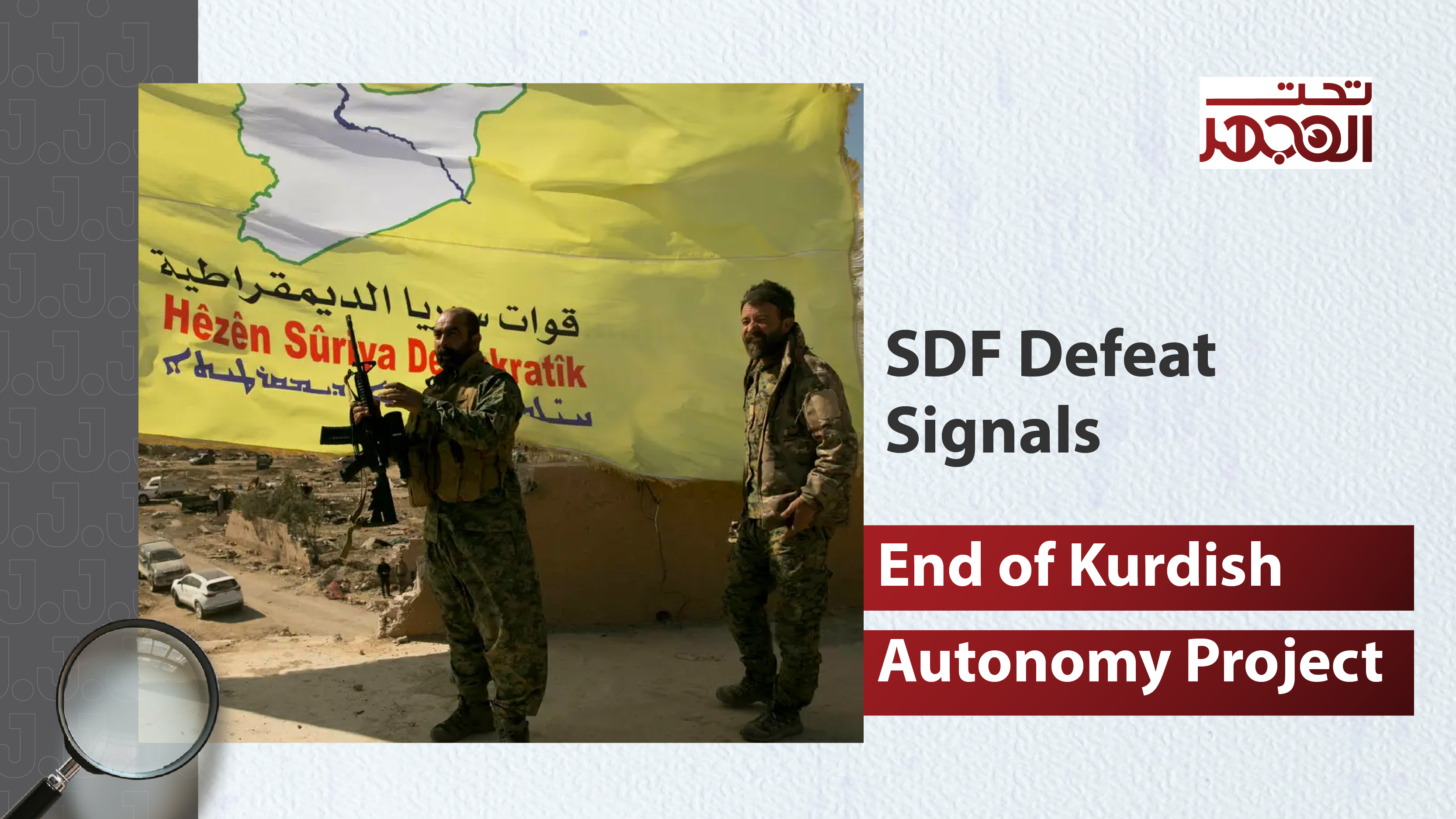
SDF Defeat Signals End of Kurdish Autonomy Project
On January 18, Syrian President Ahmed al-Sharaa and the commander of the Syrian Democratic Forces (SDF), Mazloum Abdi, agreed a deal including a ceasefire and the full integration of the SDF into the Syrian state. The agreement was brokered by U.S. Special Envoy Thomas Barrack, and backed by the leader of Iraq’s Kurdistan Regional Government (KRG), Masoud Barzani.
The truce followed the SDF’s most rapid and significant territorial losses since its formation in 2015. In just two days, the force lost the entire southwestern bank of the Euphrates River, as well as all of Deir Ezzor province on the northeastern bank, the city of Raqqa, and swathes of Al-Hasakah province, to Syrian government forces.
This was the most consequential of the SDF’s five military defeats since 2018, which have seen it ousted from Afrin, Tal Abyad and Ras al-Ayn, followed by Tal Rifaat and Manbij, then in December the Sheikh Maqsoud and Ashrafieh districts of Aleppo. These defeats had all chipped away at the group’s autonomy project, established in 2013 by the Democratic Union Party (PYD), the Syrian branch of the Kurdistan Workers’ Party (PKK). However it was the SDF’s ouster from Aleppo that signaled its final demise was near.
Contrary to the widespread belief that it emerged as a result of the creation of the Global Coalition Against Daesh in 2014, the effort to create a self-ruling enclave in northern and eastern Syria predates that alliance. It began with the creation of the Kurdish Supreme Council, a joint project of the Democratic Union Party (PYD) and the Kurdish National Council (KNC), after the signing of the Erbil Agreement on July 12, 2012, under the auspices of the President of the Kurdistan Region of Iraq, Masoud Barzani. The council also formed a military wing, comprised of the People’s Protection Units (YPG), the Women’s Protection Units (YPJ), and the Asayish police forces. The Syrian Democratic Forces (SDF) were formed subsequently, in 2015.
This origin explains the anger of the KNC and Barzani over the project’s state today, given the dangers posed by the PYD’s alliance with the PKK, its exclusion of the KNC, and its refusal to implement the March 10, 2025 agreement with the new Syrian government—thus squandering a rare opportunity offered by the collapse of the Assad regime.
Following its birth, the Autonomous Administration soon expanded geographically, taking the cantons of Al-Jazira, Kobani (Ayn al-Arab), and Afrin in 2014, and growing to six cantons in 2016. By 2023, it had transformed into the Democratic Autonomous Administration of North and East Syria (DAANES), comprising seven cantons: Al-Jazira, Deir ez-Zor, Raqqa, the Euphrates, Manbij, Afrin, and Tabqa.
This geographical expansion was accompanied by a growth in the administration’s military and security apparatus, as well as its civilian institutions, which employ tens of thousands of personnel. The SDF and Damascus have been in negotiations over these institutions and their integration into the Syrian state, as well as the management of the geographical areas the SDF controlled.
Since 2018, the Autonomous Administration has successively lost Manbij, what remained of the Afrin canton, and the Martyrs’ Canton, along with neighborhoods in Aleppo, Tabqa, Raqqa, and Deir Ezzor. It also lost all the territory it had seized after the fall of the Assad regime east of Aleppo. It now only controls a portion of the Al-Jazira canton, having lost part of the southern countryside of Al-Hasakah, along with the Euphrates enclave (Ayn al-Arab). With these defeats, it lost all its military, security and civilian institutions in those areas.
This means that the new agreement only encompasses the remaining areas the Autonomous Administration holds in Al-Hasakah (Al-Jazira) and Kobani (the Euphrates canton), along with the remnants of its armed groups, believed to be overwhelmingly Kurdish and affiliated with the PYD. These remaining fighters are expected to number only a few thousand, since most—or all—Arabs have left the area.
In either case, the deal concerns their integration into Syrian government institutions, which would effectively dissolve the DAANES and all its affiliated entities, notably the Syrian Democratic Council, the Peoples’ Democratic Council, and the administration’s services and municipal councils.
In conclusion, what remains of the project for a self-governing enclave is contained in Legislative Decree No. 13 of 2026, which grants Syria’s Kurdish citizens numerous political, constitutional, and cultural rights, while SDF commanders and DAANES officials might eke out more gains from the new agreement signed between Abdi and President al-Sharaa.