The EU’s New Roadmap for Engagement with Syrian Civil Society
Introduction
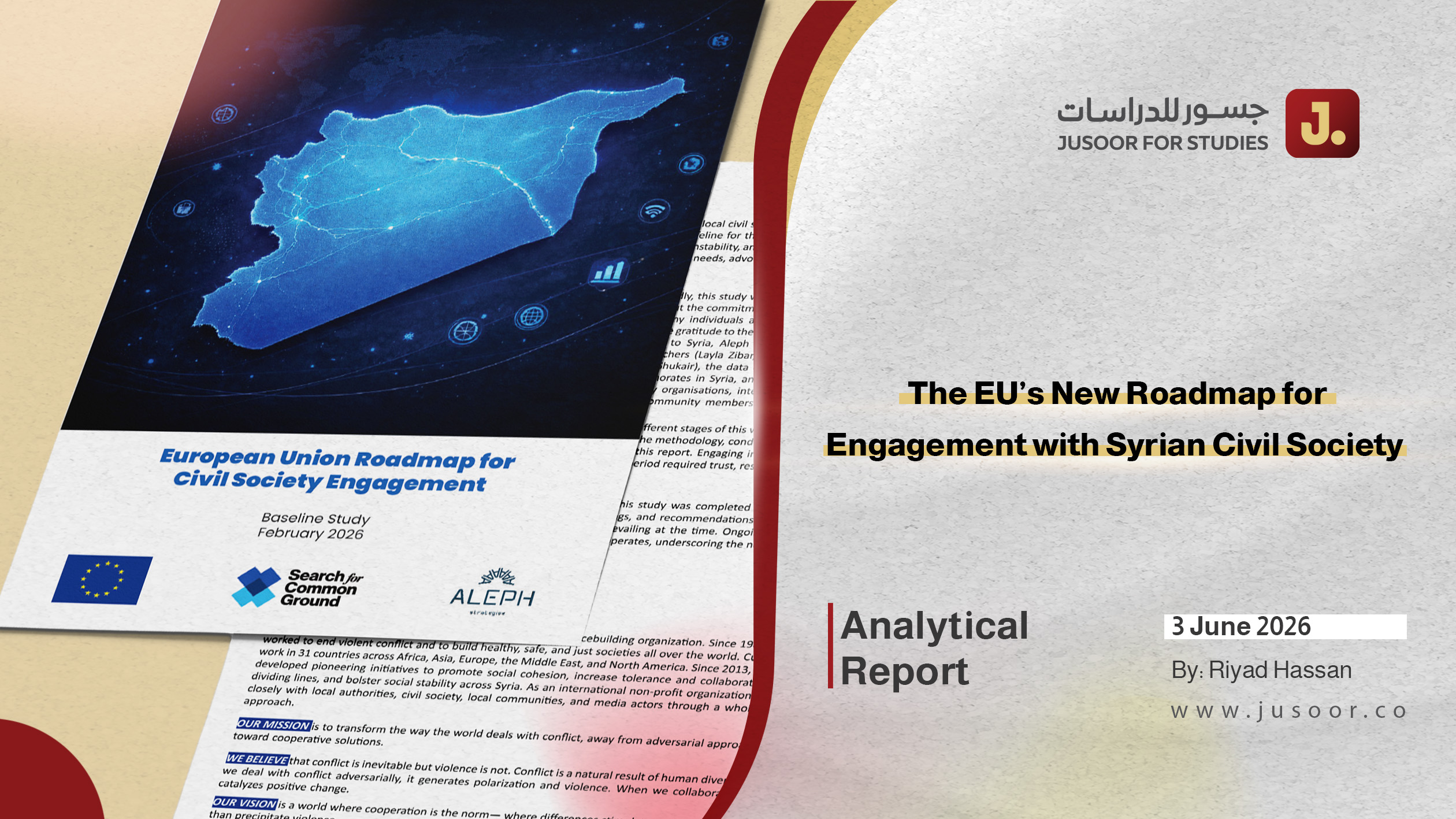
The European Union published a new roadmap in May for its engagement with Syrian civil society.[1] This revised version of a 2023 strategy reflects the political, security, social, and economic transformations that Syria has undergone since, most notably the fall of the Assad regime in December 2024 and the formation of the new Syrian government in March 2025.
According to the roadmap, published by consultancy ALEPH Strategies, these shifts have plunged the country into “a period of heightened uncertainty”:
“These changes necessitate a reassessment of the assumptions underpinning the Roadmap and frame the baseline as a measurement taken during a transitional moment rather than within a stabilised post-conflict setting,” it reads.
The EU had first published its roadmap for engagement with Syrian civil society in June 2023, as a strategic document and guiding mechanism for organizing funding, partnerships, and dialogue with Syrian Civil Society Organizations (CSOs). The roadmap included four main priorities: the Representation of Civil Society; Deliberative Democracy; Public Well-Being; and Self-Constitution. It was based on a broad consultative process aimed at analyzing the true state of Syrian civil society and soliciting the views of the organizations that comprise it, as well as international stakeholders and representatives of the Syrian diaspora, ensuring that the resulting priorities were evidence-based and represented a wide spectrum of voices.
1. The EU’s Assessment of the Current Situation in Syria
The new roadmap provides a comprehensive assessment of the current situation in Syria and its impact on the environment in which civil society operates, on four main levels: political, humanitarian, economic, and security. It concluded that these factors, taken together, continue to limit the ability of Syrian civil society to become a stable and influential actor during the transitional phase.
Politically, the new roadmap reveals that the interim political system remains fragile and highly centralized, with power concentrated within a narrow executive structure. Political participation is far from equitable, as key segments of Syrian society, particularly Kurds, Druze, Alawites, and Christians, as well as women across all groups, remain underrepresented. Furthermore, the civic space has opened selectively rather than inclusively, influenced by the dynamics of the local authorities and their regulations governing civil society activities.
In humanitarian terms, the roadmap observes that the humanitarian sector continues to suffer from severe underfunding, while administrative restrictions continue to constrain civil society’s activities. The dual reality of narratives around reconstruction, coupled with ongoing humanitarian dependency, places CSOs in a complex position, forcing them to navigate competing expectations, funding mechanisms, and high political sensitivities.
Economically, the study shows that Syria remains in dire straits, with widespread poverty, high inflation, unemployment, and a volatile currency still key aspects of daily life for the majority of the population. While the easing of sanctions has allowed for limited economic activity and investment, entrenched corruption, elite control, and weak oversight mechanisms are hindering a comprehensive recovery.
In terms of security, the roadmap notes that large-scale military confrontations have decreased significantly. Yet localized violence persists, fueled by unresolved grievances, sectarian tensions, and competition among armed groups. Mass violence in the coastal and southern governorates highlights the dangers of collective punishment, weak reconciliation mechanisms, and perceptions of bias in interventions by the security forces.
All these dynamics directly impact the sustainability of civil society. Access to diversified sources of funding remains limited, banking and compliance barriers persist, and reliance on short-term external funding continues to shape organizational behavior. CSOs continue to operate within a context of increasing social divisions, displacement, and mistrust, while security conditions further complicate the operating environment for civil society.
Given this situation, the document shows that Syrian CSOs remain cautious and hesitant, in the face of persistent structural constraints, limited influence on policymaking processes, and unequal access to funding, as well as organizational opacity, weak accountability mechanisms, and general skepticism associated with dependency on donors. Thus, the legitimacy of civil society remains tied to their environment; CSOs appears stronger when it comes to service delivery, while they have little formal political influence or presence in long-term institutional work. The document concludes that this places civil society at a crossroads: It is neither fully constrained nor fully supported, but rather operates within a transitional environment characterized by partial openings, persistent risks, and profound structural challenges.
2. Why Revise the Priorities of the EU’s Previous Roadmap?
The new roadmap recognizes that the transformations Syria has undergone since the first version was published necessitate a review of the EU’s priorities related to Syrian civil society. This review was prompted by shifts in the political, civil, and humanitarian landscape, and their direct repercussions on the effectiveness of the previous approach and its continued relevance to the evolving situation in Syria.
• The need to clarify the EU’s role: The previous roadmap risked presenting EU support to civil society as a substitute for support to the Syrian government. This necessitated a reformulation of the European approach to emphasize the complementary nature of Europe’s role and to reaffirm the principle of shared responsibility in civil society development, as a crucial entry point for strengthening donor confidence and mobilizing additional support.
• The need to review and strengthen the role of civil society. Despite the capacity of CSOs to play a greater role in governance and decision-making, that role remains limited or absent in many contexts. CSO’s work is often still confined to service delivery, while they have limited opportunities to influence other areas of public policy or advocate for the priorities of local communities. Therefore, the roadmap emphasizes the importance of recognizing civil society as a partner in more inclusive and responsive governance and decision-making.
• The need for clearer and more inclusive priorities, given the changing political and civic landscape in Syria. The new context has altered the nature of the actors able to participate in the civic sphere, the entities whose voices are heard, and the issues that receive attention. Despite the emergence of a greater margin for action and participation, civil society continues to be affected by the marginalization of grassroots organizations, women, youth, and local actors. This necessitates a re-examination of priorities to focus explicitly on inclusivity, strengthen the role of civil society in advocacy, and better reflect the diversity of actors and capacities within the Syrian civil infrastructure.
• The need to review peacebuilding priorities and funding mechanisms. Current operational models continue to limit the ability of CSOs to balance immediate humanitarian responses with long-term goals of peacebuilding and social cohesion, amidst ongoing security and economic challenges and social fragmentation. Furthermore, prevailing approaches by donors, which tend to favor large organizations and procedural compliance requirements, limit the ability of small local organizations to contribute effectively to this agenda. This necessitates a re-evaluation of funding priorities and mechanisms in order to enable local actors to have a greater impact by strengthening social cohesion and improving the well-being of local communities.
• The need to prioritize based on the needs of local communities in all Syrian governorates, in parallel with a realistic assessment of what CSOs can offer and the roles they can play more effectively, as well as identifying how donors can support these organizations in line with the actual needs of local communities.
3. Priorities of the New Roadmap
The EU’s new strategy proposes just three main priorities: Organizational Sustainability, Participatory Governance, and Community Resilience. The previous roadmap’s priorities of civil society representation and self-constitution were merged under the heading of Organizational Sustainability, while the concept of deliberative democracy was replaced with that of Participatory Governance, in order to align the European approach with the deeply divided Syrian context by strengthening inclusive spaces for dialogue and linking community deliberations to governance and decision-making processes, thereby helping to rebuild trust, reduce exclusion, and pave the way for future democratic reform.
The priority of public welfare has also been replaced with that of community resilience. This new priority focuses on enhancing the role of civil society in recovery and resilience at the local level. It aims to empower CSOs to maintain and expand reconciliation and social cohesion programs, while also more clearly linking economic recovery and livelihood efforts to peacebuilding pathways.
The new roadmap focuses on two main dimensions:
1. Upgrading the EU’s partnership with the Syrian government
The EU’s new approach aims to reassign responsibility for providing essential goods and services such as food, water, electricity, education, health, and so on, to the Syrian government, as the primary entity responsible for managing these sectors. Many of these areas were previously managed by CSOs—both in regime-held areas, due to the European boycott and international sanctions, and in opposition-held areas, due to the terror designation against Hayat Tahrir al-Sham. This situation has changed radically over the past 18 months.
Through this approach, the EU aims to leverage its openness to the Syrian government, encouraging it to respond to the demands of the political process laid out by UN Security Council Resolution 2254 (2015), particularly regarding the formation of an inclusive government representing all parts of Syrian society, the drafting of a permanent constitution that guarantees comprehensive representation, and the holding of free and fair general elections under international supervision. Europe sees these as key steps toward establishing genuine and sustainable stability in Syria.
Furthermore, the EU’s approach is built on the belief that strengthening its partnership with the Syrian government can support a number of European interests, primarily the return of refugees, security cooperation in combating terrorism, and the fight against drugs and organized crime, in addition to economic issues and reconstruction. It is also linked to balancing the EU’s regional and international relations, particularly with Türkiye (regarding the Eastern Mediterranean and maritime border demarcation), and with Russia, in light of the war in Ukraine, the nature of the Russian military presence in the Mediterranean, and its impact on European influence in Africa.
2. Reorienting the Role of Syrian CSOs
The new European approach focuses on reducing CSOs’ emphasis on providing public services, directing them instead towards activities related to peacebuilding and community governance. This aims to minimize overlap between their roles and those of government institutions and to alleviate the legal restrictions and obstacles that these organizations have long complained about.
This approach aligns with the UN’s 2026 Humanitarian Needs and Response Plan (HNRP) for Syria. The European bloc’s new strategy focuses on the areas best suited to civil society activity, enabling it to achieve a more effective impact on peacebuilding, social reconciliation, civil peace, national dialogue, the role and participation of women in political and social life, minority rights, children’s rights, human rights more generally, freedoms, transitional justice, and the fight against hate speech, incitement to violence, and sectarianism.
The roadmap also aims to break the dominance of large organizations in partnering with the EU and taking the lion’s share of its funding. The roadmap also aims to integrate small organizations that have emerged since the fall of the regime, to turn them into partners with the EU and beneficiaries of European funding. Furthermore, it seeks to build a more balanced approach in dealing with all the governorates of Syria, creating a more cohesive and integrated project that is also integrated with the Syrian government, thus serving the EU’s overall objectives and strategy for the country.
Conclusion
The EU’s new roadmap sketches out the bloc’s future relationship with Syrian civil society, with the goal of redirecting it away from its current key responsibility of simply providing services, a role directly linked to the Syrian government. This is accompanied by a European drive to enhance its economic partnership with Damascus, especially after the lifting of European sanctions and the reactivation of the EU-Syria Cooperation Agreement.
The new European approach seeks to reduce the overlap in roles between the government and CSOs. This could encourage the government to ease restrictions that civil society perceives as hindering its work, while simultaneously guiding civil society towards issues more aligned with its nature and function, such as peacebuilding, social reconciliation, and civil peace, and related initiatives.
[1] The European Union defines Civil Society Organizations (CSOs) as non-governmental, non-profit, non-partisan, and non-violent structures through which people organize themselves to achieve common political, social, economic, or cultural goals. They include community organizations, trade unions, research, professional, media, youth, religious, and other institutions.
Araştırmacılar
Member of the Studies Unit team Focuses on political tracks and actors in Syria. Former member of the Syrian National Coalition for Opposition and Revolutionary Forces. Member of the Syrian Constitutional Committee Bachelor's degree in Agricultural Engineering.