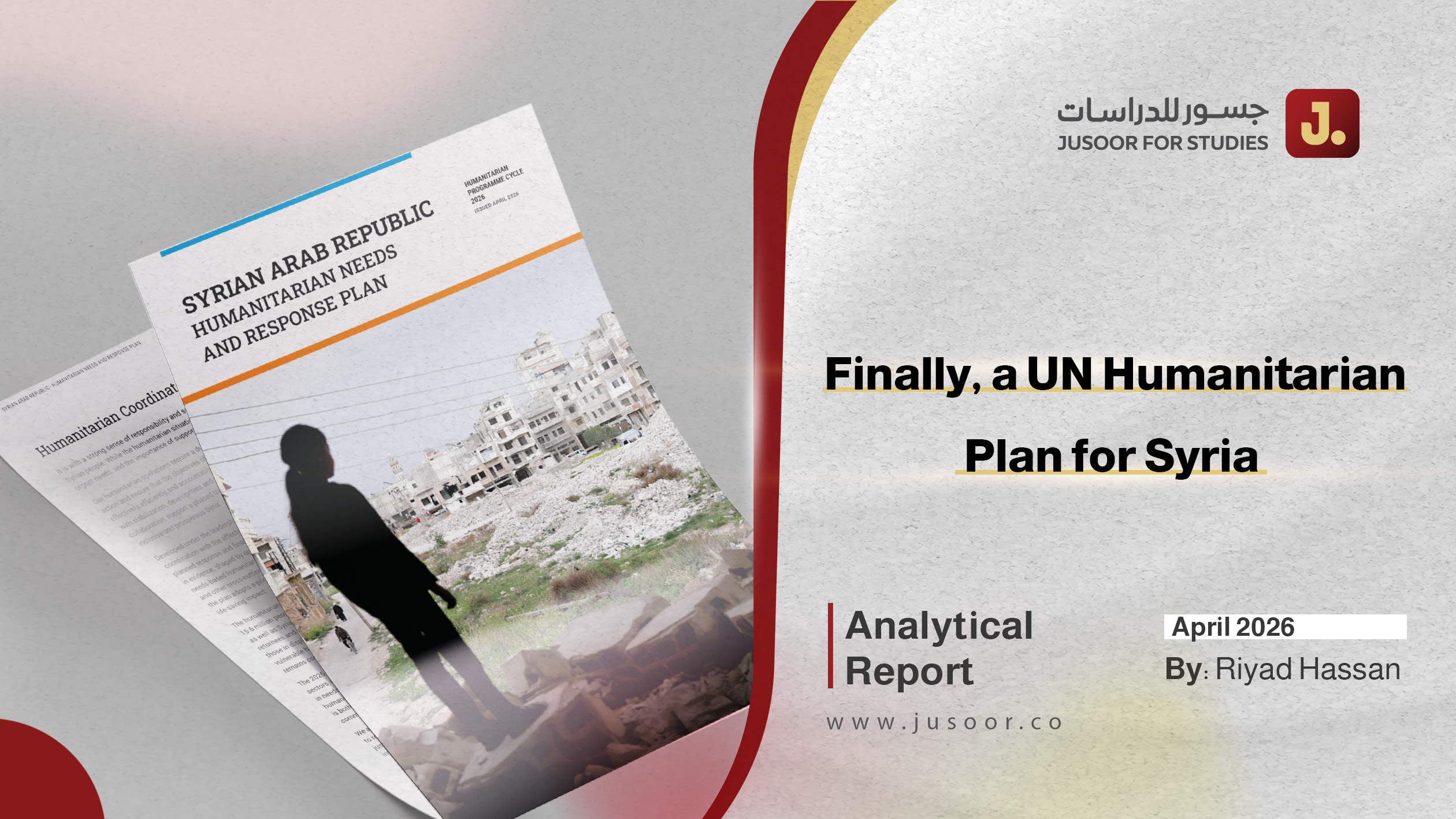
Finally, a UN Humanitarian Plan for Syria
The Syrian government, which rejected two previous UN aid plans, has finally accepted a new humanitarian strategy to help the country recover from years of brutal conflict. The new plan, launched on April 2 during a visit by top UN humanitarian officials Tom Fletcher and Alexander de Croo, was welcomed by the Foreign Ministry’s international cooperation chief, Qutaiba Qadish.
When the new government toppled the Assad regime, it inherited a UN aid plan presented just weeks earlier, on November 4, 2024. The new authorities in Damascus never implemented this, so the UN launched another “Transitional Action Plan for Syria” in March 2025, covering 12 programmatic areas—from financial sector reform and reconstruction to disarmament and refugee returns. Yet a year on from its launch, the UN and Damascus had failed to reach an agreement on how to implement it, thus necessitating a new strategy.
The new plan, comprising 81 pages, prioritizes recovery and response in just four areas: restoring vital infrastructure; resuming essential services; strengthening socio-economic resilience; and rebuilding public institutions. It also addresses the clearance of mines, explosive ordnance, and other remnants of war.
The plan estimates that some $2.9 billion is needed in 2026, to assist 8.6 million of the 15.6 million people in need in Syria. It stresses that these ambitions are limited, and that the plan reflects the limits of the funding available, and do not ignore the importance of other needs. It notes, the structural drivers of need in Syria cannot be addressed through humanitarian aid alone.
Given the lack of funds, the plan anticipates that humanitarian needs in Syria will remain huge in 2026 due to displacement (both ongoing and new), protection risks, intermittent conflict, limited access to basic services, an ongoing food security and malnutrition crisis, socioeconomic challenges, and the repercussions of environmental shocks.
The plan lays out the humanitarian response needs of some 438,000 Palestinian refugees in Syria separately, envisioning their delivery via the UN Relief and Works Agency for Palestine Refugees (UNRWA). This aid is to include cash transfers, food assistance, healthcare (through support for 25 medical facilities), and support for education in over 100 UNRWA schools serving approximately 50,000 students. The plan also includes provisions for water and sanitation services in Palestinian camps, as well as addressing the needs of communities affected by bouts of violence in the coastal region, Suwayda, and northeastern Syria.
Sharaa’s Shifts
The government appears to have rejected the previous plans due to its perception that they constituted a form of foreign interference in Syria’s domestic affairs. Damascus also took issue with the linking of humanitarian aid to government compliance with the plan’s “political” demands. Furthermore, the strategy was developed under the leadership of the UN’s Humanitarian Coordinator, in consultation with the Office of the Special Envoy to Syria and humanitarian partners—but without consultation with the government in the assessment of needs or priorities.
Moreover, the government has criticized the UN for granting itself extra powers. For example, the UN Country Team had appointed itself as a bridge between international financial institutions and the Syrian government to help formulate policy in line with international standards, on the basis that otherwise, Syria would struggle to transition and rebuild its basic economic structures.
The Syrian government also criticized the UN’s role in mapping out preparatory plans, assessing needs, and designing and implementing measures to support constitutional reform, national dialogue, and elections—as well as reforms in the security, judicial, and media sectors, transitional justice, social protection, and elsewhere.
By contrast however, the government has approved and welcomed the new plan, for two main reasons. Firstly, the strategy is limited to just four areas, all related to humanitarian issues. It omits any political intervention, such as in the constitution or elections, and avoids addressing the issue of much-needed reforms in the legal, judicial, media, and security sectors, as well as the financial sector. It does not deal with the state’s approach to disarmament, demobilization, reintegration, and transitional justice.
Secondly, the new plan explicitly commits the UN to respecting Syria’s national sovereignty, emphasizing that all its engagement will be implemented in coordination with Syrian state institutions, in accordance with the UN Charter, UN General Assembly Resolution 46/182 (the foundational framework for UN humanitarian assistance), and subsequent UNGA resolutions on strengthening the coordination of UN emergency humanitarian assistance. These resolutions all affirm that humanitarian intervention must only be delivered at the request of, and in coordination with, the Syrian state.
Reference to these resolutions had been a point of contention between Western countries—which under the previous regime had pushed the UN Security Council to authorize cross-border aid deliveries without the permission of the former regime—and Russia, which demanded the implementation of these resolutions and respect for the principle of Syrian sovereignty.
Therefore, it is noteworthy that Qadish, Director of the International Cooperation Department at Syria’s Ministry of Foreign Affairs, affirmed that Syria welcomes the new plan and the UN’s commitment to working, consulting, and coordinating with state institutions while fully respecting the country’s sovereignty, territorial integrity, and independence.
Finally, it the Syrian government appears to have preempted the plan’s unveiling with a decision issued by Qadish’s department on March 12, abolishing a mechanism for the UN to work with the Syrian Arab Red Crescent and the Syrian Development Organization as national partners. The new ruling prohibits them from signing or concluding such agreements unless they coordinate with the department.
A Radical Shift
In summary, the UN’s Assad-era humanitarian plan considered the divisions in the country at the time, when some areas fell outside the Assad regime’s control. It aimed to deliver aid to the whole of Syria, but with needs assessments conducted both by the regime and with de facto authorities in northern, northwestern, and northeastern Syria, as well as implementing a mechanism for delivering aid across borders in accordance with Security Council resolutions, excluding any role for the regime.
When the second plan was launched, the UN was still referring to the government as the “interim authorities,” implying that it lacked legitimacy and had failed to complete the political transition demanded by UNSC Resolution 2254 (2015). Yet Damascus has since made progress on these steps, forming a representative government, issuing a constitutional declaration, and holding parliamentary elections. Moreover, it has received growing international recognition, particularly after a meeting between President Ahmed al-Sharaa and his U.S. counterpart Donald Trump. The lifting of a terror designation against the Hayat Tahrir al-Sham, as well as the lifting of international sanctions on Syria, have also helped. All this has bolstered the government’s position in terms of the principle of sovereignty in humanitarian aid plans and the principle of non-interference in its internal affairs, based on the UN Charter and resolutions.
The Syrian government has thus successfully pressured the UN to take its concerns into consideration and implement a radical shift in the humanitarian response plan, in accordance with the principles of neutrality governing humanitarian work, ensuring that communities in need are not impacted by political stances, and of contributing to the country’s stability and mitigating any potential negative economic, social, and security repercussions from Israel’s wars on Gaza, Lebanon, and Iran.
Araştırmacılar
Member of the Studies Unit team Focuses on political tracks and actors in Syria. Former member of the Syrian National Coalition for Opposition and Revolutionary Forces. Member of the Syrian Constitutional Committee Bachelor's degree in Agricultural Engineering.