Sending a Message: Iran Continues Attacks in Syria
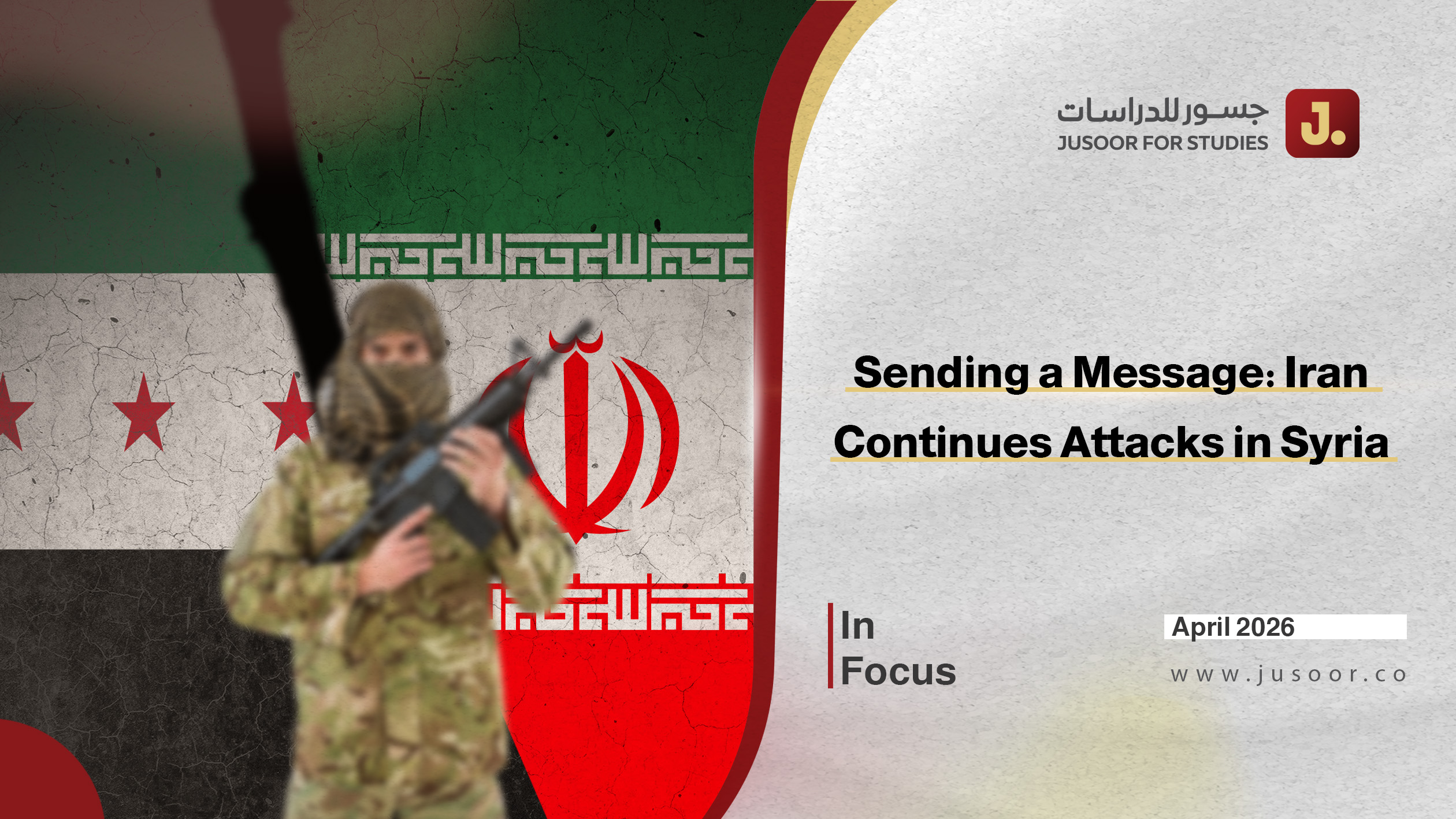
Between February and April, Iran-linked militants carried out increasingly bold attacks across Syria, despite Damascus declaring its neutrality in the U.S.-Israeli war on the Islamic Republic and striving to avoid Syria becoming a proxy battleground.
Since the war began on February 28, a series of attacks have taken place within Syria and along its borders. Two cells linked to Hezbollah were dismantled in Damascus; one had carried out missile and drone attacks on the Mezzeh military base and around the adjacent airport, while the other had attempted a bombing in the mainly Christian neighborhood of Bab Touma. Meanwhile, military facilities in eastern Syria were repeatedly hit by missiles and drones, likely launched from Iraqi territory, while artillery shelling from across the Lebanese border targeted Syrian army positions in Rif Dimashq province. Iran has also issued direct threats against key government facilities in the capital.
These developments reflect a shift on Iran’s part, from simply avoiding direct attacks to adopting a multifaceted strategy of pressure—combining security operations in Syrian cities, cross-border strikes, and threats in the media—all while avoiding open confrontation. This marks an important evolution, as Syria had for some time been spared direct attacks with Iran, despite the latter’s widening regional confrontation with its adversaries. Tehran, meanwhile, has been careful to maintain its networks in Syria while avoiding exposing them. Syria also lacks direct American targets, and according to Russian assessments, remains relatively insulated from the regional conflict.
However, as war has continued and expanded, while and Syria has tightened security measures on its borders with Iraq and Lebanon, all of which appears to have prompted Iran to change its behavior. It is now using its proxies, particularly Iraqi militias and Lebanon’s Hezbollah, to carry out limited attacks under the guise of targeting American interests, despite Damascus announcing that there had been no American military presence at these sites since February 2026. In short, Iran is using Syria as a space where it can exert indirect pressure on its adversaries.
More generally, Tehran’s attacks on Syrian soil can be interpreted in several ways. Firstly, it is seeking to test the nascent Syrian army’s capabilities attempting to weaken it during its reconstruction phase while stopping short of provoking a full-scale confrontation, and raising the cost of stabilizing the country. Iran is also responding to Syria’s success in securing its borders and thwarting infiltration and smuggling attempts, as Iranian militias continue to rely on Syrian smuggling networks. Furthermore, these operations serve to send a message to the U.S. that Iranian proxies remain active and capable of influencing the course of the conflict.
Whether these attacks continue will in large part depend on the outcome of the regional de-escalation between Iran and the U.S. If the mid-April truce holds, the attacks are likely to continue in a low-key and carefully calibrated manner: sporadic operations that use Syria as a conduit for messages, thus achieving Iran’s objective of exerting pressure.
However, if the de-escalation falters or collapses, Syria could become an arena for further escalation, whether through intensified attacks by Iraqi militias or an expansion of Hezbollah’s activities, thereby increasing the possibility of a direct confrontation.
The bottom line is that Iranian attacks in Syria are unlikely to cease in the foreseeable future. Rather, they appear to be adapting to the trajectory of the regional conflict, escalating or de-escalating depending on the relationship between Tehran and Washington. Syria is likely to remain a proxy battleground for some time to come.