Border Flag Raises New Questions Over Northeast
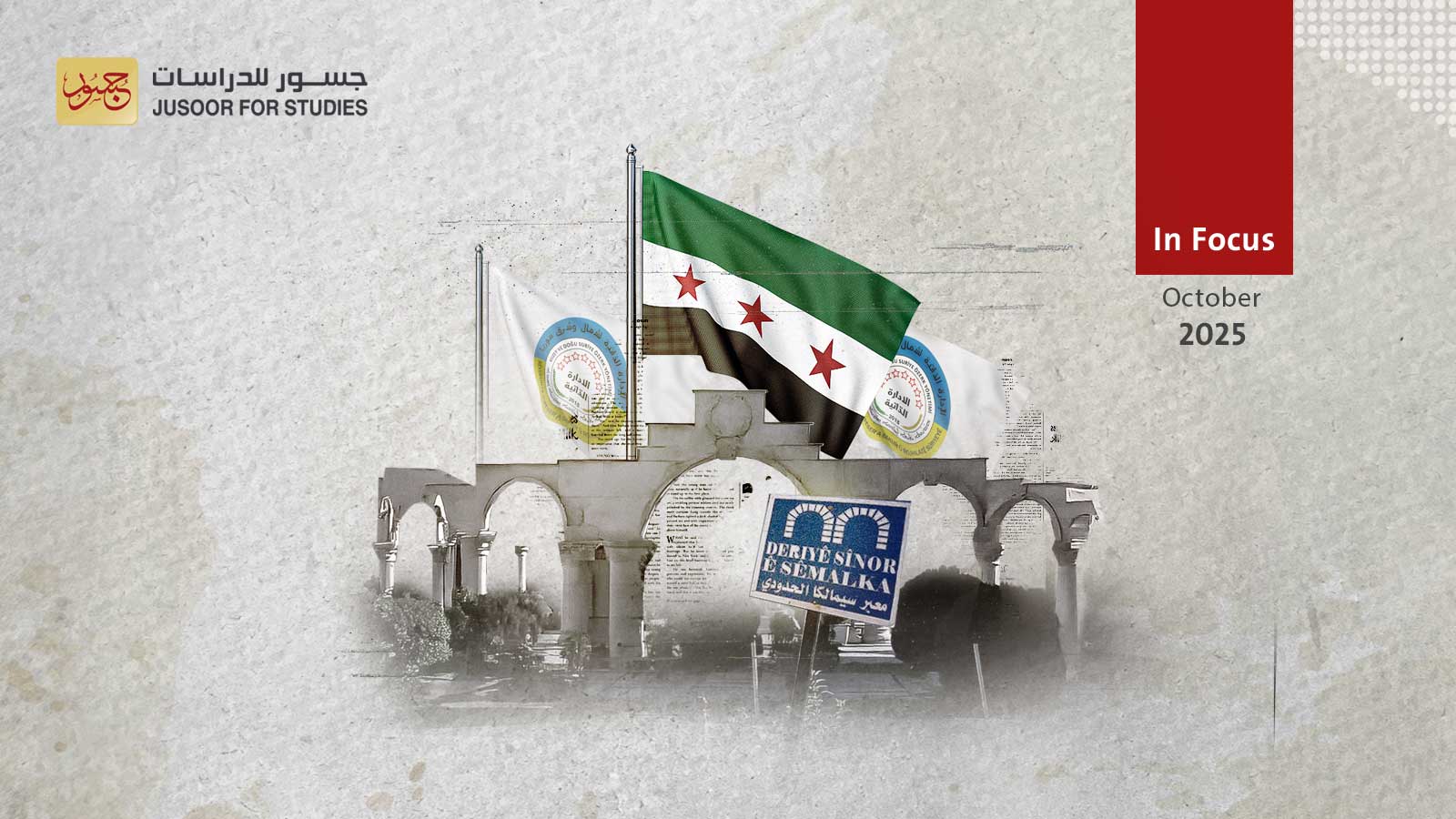
Authorities in northeastern Syria have raised the Syrian national flag alongside their own at the Semalka border crossing, which joins territory controlled by the Autonomous Administration of North and East Syria (AANES) to that of Iraq’s Kurdistan Regional Government (KRG).
The casual observer might conclude that the flag represents a symbolic first step toward implementation of the March 10 deal between Syrian President Ahmed al-Sharaa and the commander of the Syrian Democratic Forces (SDF), Mazloum Abdi, which stipulates that border crossings be integrated into the Syrian state.
Yet a closer look reveals that the move was not intended as part of that agreement, nor as a preliminary step towards its implementation. A spokesperson for the AANES delegation at talks with Damascus said that flying the Syrian flag at the Semalka crossing was a standard procedure under Article 8 of the regional administration’s 2024 Social Contract, which stipulates that the flag of the Syrian republic fly alongside that of the AANES.
This raises new doubts over the March 10 deal, as it implies that the autonomous administration believes the outcome of the talks must be consistent with the “social contract,” which serves as a constitution for northeastern Syria. Damascus, meanwhile, is operating in accordance with its own constitutional declaration, issued following the overthrow of the Assad regime.
The raising of the flag in this way establishes a new framework and a new reality for negotiations between Damascus and the AANES, demanding a recognition that Syria has two constitutions—both of which must be considered in implementing the March agreement. Conversely, the AANES will see any part of the agreement that is not consistent with the social contract as null and void.
Imposing such a framework on the talks could have far-reaching implications, affecting everything from the official name of the Syrian state to the form of government, the borders of the northern and eastern regions of Syria, the state’s official languages and recognized religions, the management of wealth and natural resources, property rights and restrictions on ownership in the autonomous areas, and the justice system.
The biggest obstacles would likely be related to military bodies and how they are integrated into the Syrian state, as stipulated in the March agreement. In particularly, the move poses new questions over the future of the Syrian Democratic Forces (SDF), which the Social Contract stipulates are to organize themselves semi-independently within the region, under a federal system.
Seen in this light, the raising of the national flag can be interpreted politically as a provocative step by the AANES toward the Syrian government, an attempt to hobble implementation of the March agreement still further. The timing is also significant, as it follows Israeli and American pressure on Damascus to make concessions in a stalled security agreement with Israel, due to the latter’s demands for a “humanitarian corridor” into the southern province of Suwayda.
The Israeli drive prompted sudden discussions over reopening the Qamishli-Nusaybin crossing with Türkiye, then the raising of the national flag over the Semalka border post, which amounted to a claim that it had transformed from an illegal crossing, unrecognized by the Syrian state, into a regular one—simply on the grounds that the flag flew above it.
Faced with this situation, the Syrian government should file complaints with the Iraqi federal government and the KRG, asking them to close the Faysh-Khabur crossing on the grounds that the Syrian part of the crossing is illegal, and to hold them responsible for the resulting threats to Syrian, Iraqi, and regional security due to infiltration and smuggling of weapons by Kurdistan Workers’ Party (PKK) fighters.
The government should also inform the AANES that raising the Syrian state flag over any civil or military institution in the northeast will only be seen as implementing the March 10 agreement if these institutions are actually administered by the Syrian state—and that the administration must engage in negotiations based on that agreement and subject to the Constitutional Declaration and the laws in force in the country, not the social contract and the laws in force in AANES-controlled areas.