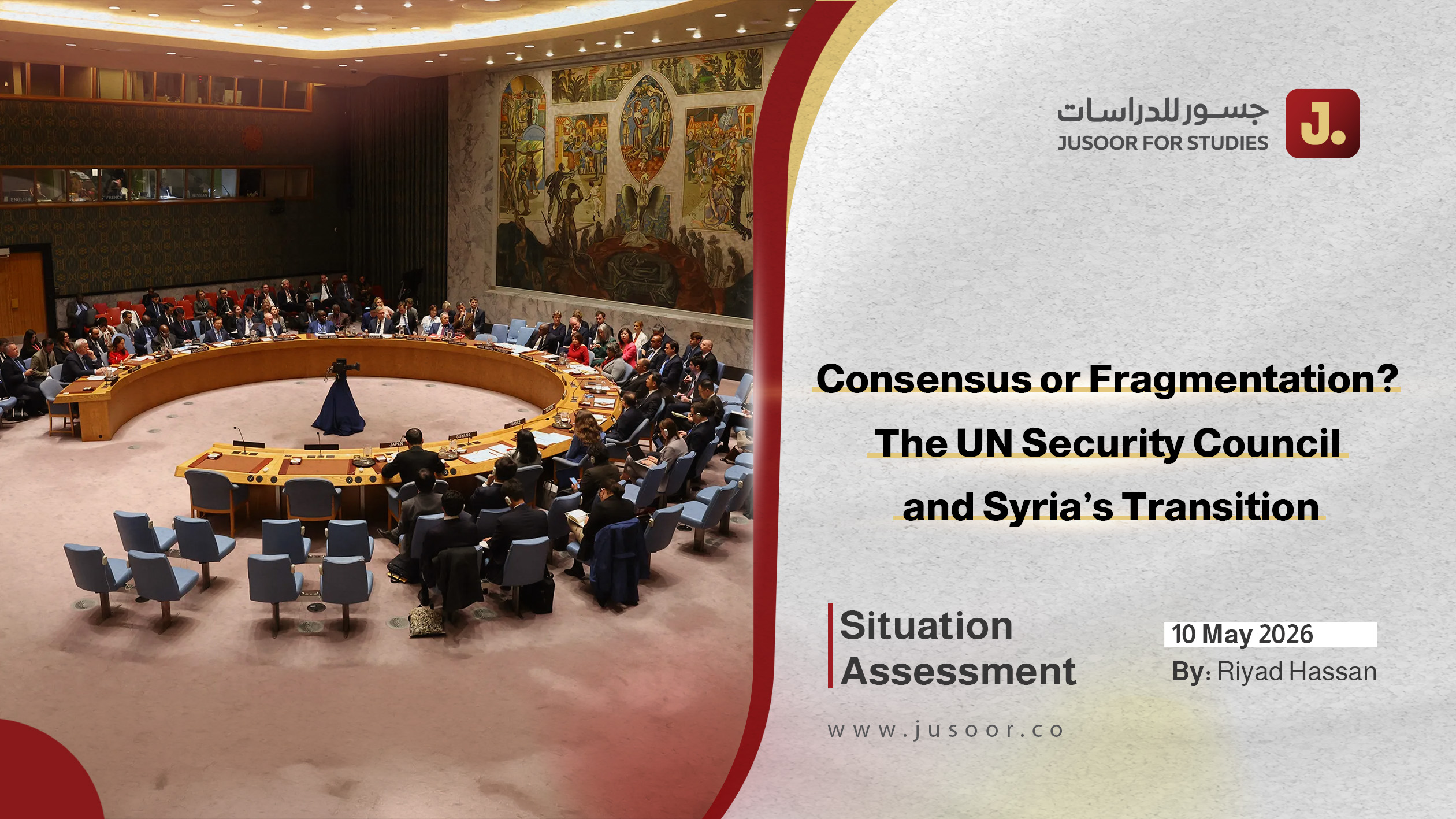
Consensus or Fragmentation? The UN Security Council and Syria’s Transition
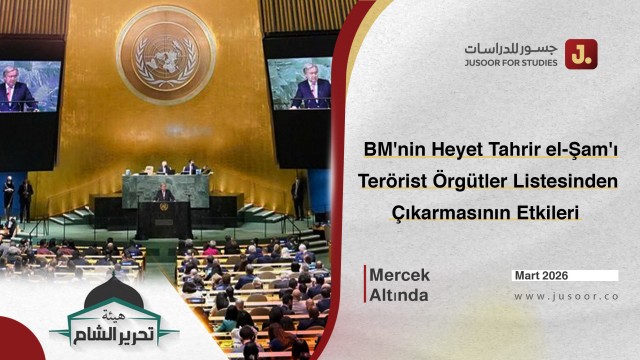
Since the fall of the Assad regime, members of the UN Security Council have shown a remarkable degree of consensus over Syria’s political transition. This can be seen in their support for the political transition process under Resolution 2254 (2015) and the Council’s recognition of the new Syrian government, which allowed it to take up Syria’s seat at the UN. In addition, the Council has taken significant steps to ease UN restrictions, such as by lifting sanctions against President Ahmed al-Sharaa, Interior Minister Anas Khattab, and militant group Hayat Tahrir al-Sham.
Yet this consensus is not set in stone. It rests on a convergence of interests among the major powers for the time being, rather than a unified vision for Syria’s future. This is demonstrated by differences in their approaches to the Syrian file—differences which have yet to culminate in a complete breakdown, but which could escalate into wider divisions on the Security Council if international pressures intersect with setbacks in Syria’s transition.
The Nature of the Consensus
The Security Council’s relative unanimity on Syria is not based on a deeper political consensus among its members. Rather, they agree in practice on a set of general principles, most notably the drive to preserve Syria’s unity and sovereignty, to support its stability, to prevent the resurgence of the Islamic State group, to manage the repercussions of Syria’s domestic conflicts, and to maintain UNSC Resolution 2254 (2015) as the international framework governing the political process.
This consensus has, in the past, allowed for steps that had previously been unimaginable, such as engaging with the new Syrian administration, treating it as the country’s internationally recognized government, and easing certain restrictions related to UN sanctions and designations. Furthermore, reciprocal visits between Syrian officials and member states of the Council, who have sent delegations on visits to Damascus, have all helped consolidate this approach and give it an institutional character. All members of the Council sent delegates to the Syrian capital in early December 2025, while high-ranking Syrian government officials have visited the capitals of all five permanent member states.
However, this consensus has continued to operate within clear limits. Not all members of the Security Council view Syria from the same perspective. The U.S. tends to focus on its own security gains in the region, particularly the weakening of Iranian influence, the fight against IS, and efforts toward regional de-escalation. European countries have focused more on nurturing Syria’s political transition, the rights of various groups, social stability, and human rights issues. Russia and China, for their part, have approached the Syrian question from a broader perspective linked to their positions in the international system, the sensitivity of issues over sovereignty, countering Western influence, and their own security interests.
Therefore, the current consensus is more functional than strategic, which makes it vulnerable to collapse at the first major test. Growing divergences in approaches to the Syrian issue have emerged at UNSC deliberations and in the positions of member states, even if these have not translated into institutional rifts within the Council—yet. Such rifts could arise when differences in priorities or diplomatic language escalate to the point where Council members obstruct resolutions, resort to vetoes, prevent the Council from taking joint positions, and crystallize of sharp divisions over the Syrian government and the political transition process.
For now, all members of the Council agree on the general principles: supporting Syria’s unity and stability, preventing a return to chaos, the continuation of the political process, and the need for the Syrian government to cooperate with the UN. However, disagreements have begun to emerge regarding the meaning of these principles and how to implement them. For some countries, supporting stability may justify a rapid rapprochement with Damascus, while others believe that stability cannot be established without clear progress on political inclusivity, addressing the concerns of various sectors of Syrian society, and launching a more transparent constitutional and electoral process.
The process underway represents more of a gradual erosion of the Council’s unified approach than a complete breakdown of consensus. But if this erosion continues without sensitive domestic issues being addressed, these differences could transform into more pronounced divisions.
International Pressures Against Consensus
The U.S.-China Rivalry
The U.S.-Israeli war on Iran and its implications for energy security may affect the nature of the tacit understanding between Washington and Beijing over Syria. China views Syria within a broader context linked to the balance of power in the Middle East, the security of energy routes, Iran’s position in China’s network of alliances, and Beijing’s strategic competition with the U.S.
As Sino-American relations become increasingly strained, Syria may emerge as a bargaining chip or a tool for leverage by either side. This does not necessarily mean that Beijing will immediately obstruct every step related to Syria, but it does mean that the margin of understanding that had allowed for previous steps may narrow, especially if China sees the international opening toward Damascus as proceeding within a framework that strengthens U.S. influence and reduces the margin for maneuver for its own regional allies.
In this scenario, Russia might find itself closer to the Chinese position, not only because of the traditional coordination between them in the Security Council, but also because of Moscow’s sensitivity to any move that would fully hand the question of Syria to the American or Western camp.
U.S.-European Divergences
The potential for divergence within the Security Council is not limited to the relationship between Washington and Beijing or Moscow: it extends to the Western position more generally. As Washington’s representative indicated at the Security Council session in April, the U.S. tends to highlight the political transition in Syria as a regional success story—one linked to combating IS, reducing Iranian influence, and opening security and economic channels with neighboring countries.
European countries, however, appear more cautious in their assessments of the transitional phase, and typically focus on the continued threat of IS, the need to protect all of Syria’s communities, preventing the resurgence of sectarian tensions, advancing the agreement between Damascus and the Syrian Democratic Forces (SDF), implementing the roadmap for Suwayda, and achieving tangible progress in the political process. This does not mean that Europe opposes engagement with Damascus, but it does link it more closely to the domestic situation inside the country, and not just to the regional situation and security issues.
Accordingly, the American and European positions could transform from a difference in tone to a difference in the form of political support for Syria within the Security Council, especially in the case of domestic unrest or security incidents with a sectarian or regional character.
Domestic Drivers Against Consensus
A Slow Political Transition
Syria’s domestic political process represents the most important test for the Security Council’s position. The continued lack of a permanent constitution, the delay in general elections, the lack of clarity regarding mechanisms for political representation, and the limited influence of certain communities within Syria’s power structure are all issues that keep the country prey to international rivalries.
The most significant challenge, however, is the absence of a clear, credible timetable for achieving these steps. The longer the transitional phase continues without producing stable representative institutions, the more doubt will hang over international rapprochement with Damascus—especially for hesitant states—and the greater the likelihood that Resolution 2254 will be transformed from a framework of support for the new government into a tool of pressure against it. One potential source of division within the Security Council is that member states have differing views over the extent to which the Syrian government is committed to carrying through the political transition.
The Question of Foreign Fighters
The issue of foreign fighters is one of the most sensitive aspects of the Syrian file for several permanent members of the Security Council. The presence of fighters designated as or affiliated with transnational organizations—such as Turkestani fighters opposed to China, Uzbeks belonging to the anti-Russian Islamic Movement of Uzbekistan, and French fighters belonging to the anti-Western “Firqatul Ghuraba” (Foreigners’ Brigade) led by Omar Omsen—presents the Syrian government with a complex security and political challenge.
On the one hand, the Syrian government needs to address this issue in a way that does not generate new domestic conflicts. On the other hand, it cannot ignore the sensitivity of the issue for major powers, who may view it as an indicator of the government’s ability to control the security situation and prevent Syrian territory from being used as a platform for any cross-border activity. Consequently, the absence of a clear and internationally acceptable formula for addressing the issue of foreign fighters could lead some countries to reconsider their level of support for the Syrian government within the Security Council.
Ethnic and National Conflicts
The conflicts in Suwayda, the coastal region, and other hotspots of sectarian or ethnic tensions constitute pressure points for some Security Council members. While these conflicts are domestic at their root, they are susceptible to rapid internationalization due to their connection to issues such as the protection of communities, minority rights, local stability, and regional power balances.
In Suwayda, the roadmap process continues to test the government’s ability to manage the relationship between the central government and the peripheries without resorting to a heavy-handed, security-led approach. In northeastern Syria, the integration agreement with the SDF still needs a clearer path to implementation, particularly regarding military, security, and administrative matters. In the coastal region, any outbreak of widespread violence similar to that seen in March 2025 could open the door to external political and media interference and claims to protect and represent certain communities.
The sum of these issues could give some Security Council members, especially France, justification to argue that stability in Syria has not yet become institutionalized, and that engagement with Damascus requires additional conditions or guarantees.
Syria’s Relationship with the UN
The Syrian government’s relationship with the UN is key to maintaining or weakening the current consensus within the Security Council. There is international agreement that the world body should continue to play a role in supporting the political process, monitoring transitional issues, and assisting in the implementation of Resolution 2254 (2015). As such, any tension between Damascus and the UN in general could become a source of disagreement within the Council itself.
This issue is further complicated by the Syrian government’s continued opposition to the appointment of a new UN envoy, relocating the envoy’s office from Geneva to Damascus, and establishing a permanent human rights commission of inquiry. These issues could lead to new disputes within the Security Council, in addition to existing disagreements over the implementation of Resolution 2118 (2013), which mandated the destruction of the Assad regime’s chemical weapons program and the identification of those responsible for its repeated use against civilians in Syria.
Syria’s Foreign Policy
Some of the Syrian government’s foreign policy choices could influence the positions of other countries within the Security Council, especially if they are perceived as taking a hard line in major international conflicts. For example, its relationship with Ukraine could be sensitive for Russia, while its relationships with the West could be sensitive for both China and Russia if they appear to indicate a complete shift to a new political axis.
This does not mean that Damascus can avoid all international contradictions, but it needs to achieve a delicate balancing act. Any clear, abrupt shift could be reflected in the positions of the major powers within the Council, transforming Syria from a topic of relative consensus into an arena for international score-settling.
Scenarios for the Security Council and Syria
Scenario 1: Continued, Conditional Consensus
This scenario assumes the persistence of a general consensus within the Security Council, despite differences over the details. It is the most likely scenario in the near term, because few governments want to see the return of a power vacuum in Syria—nor the country’s isolation or collapse. Furthermore, stability in Syria today is linked to sensitive regional issues such as combating terrorism, border security, flows of refugees, energy security, and combating drug trafficking. However, this scenario would require that the Syrian government demonstrate gradual progress on the political transition and its dealings with the SDF and Suwayda, as well as tackling the issue of foreign fighters and improving relations with the UN.
Scenario 2: Growing Divisions While Consensus Holds
In this scenario, member states would continue to support Syria’s unity and stability, but differ increasingly in their assessments of the government and its approach. This could manifest at Security Council meetings, in the drafting of statements, or in sanctions or the conditions placed on support, while stopping short of a P5 member deploying the veto, or the complete paralysis of the Syrian file. This scenario will become more likely if internal obstacles persist, but short of a major crisis sparking sharp divisions among world powers.
Scenario 3: A Fundamental Rift at the Security Council
This scenario would materialize were several factors to converge simultaneously; for example, an international escalation between the U.S. and China or Russia, a clear impasse in the political process, the eruption of a domestic crisis in Syria, or a major crisis in the relationship between Damascus and the UN. Such a situation could cause divisions to escalate from rhetoric to efforts to obstruct resolutions, or a realignment within the Council. While this is not the most likely scenario for now, it remains a possibility unless sensitive issues are managed in a way that minimizes the chances that they become internationalized.
Conclusion
To date, the Security Council does not appear to have reached the point of a major rift over Syria. Enough common ground remains to allow for continued international engagement with the Syrian government, and as yet, there are no conclusive indications that their disagreements will escalate into systematic obstruction within the Security Council.
That said, this consensus is no longer as cohesive as it was immediately after the fall of the Assad regime. Member states have begun to voice doubts over the future of the transitional phase, the limits of engagement with Damascus, the fate of various Syrian communities, the role of the UN, and the handling of cross-border security issues.
In other words, relative international consensus on support for Damascus is evolving into more conditional support. This does not signify a break with the Syrian government, but it does mean that continued backing from the Security Council will become increasingly contingent on the government’s handling of sensitive domestic and foreign policy issues.
Therefore, the Syrian government desperately needs to preserve the unified backing of the Security Council, particularly regarding the principles of state sovereignty, unity, and territorial integrity, and to achieve the lifting of sanctions to help support the process of economic recovery, which will play a fundamental role in the country’s stability.
Although Damascus has stayed neutral and distanced itself from the U.S.-Israeli war on Iran, thus avoiding direct negative repercussions, it needs to do more to balance its foreign relations, particularly with the five permanent members of the Security Council. It must pursue domestic policies that implement Resolution 2254 (2015), defuse tensions between different groups, formulate an internationally acceptable policy on foreign fighters, and finally, review its approach to the UN and its future role in Syria.
Araştırmacılar
Member of the Studies Unit team Focuses on political tracks and actors in Syria. Former member of the Syrian National Coalition for Opposition and Revolutionary Forces. Member of the Syrian Constitutional Committee Bachelor's degree in Agricultural Engineering.